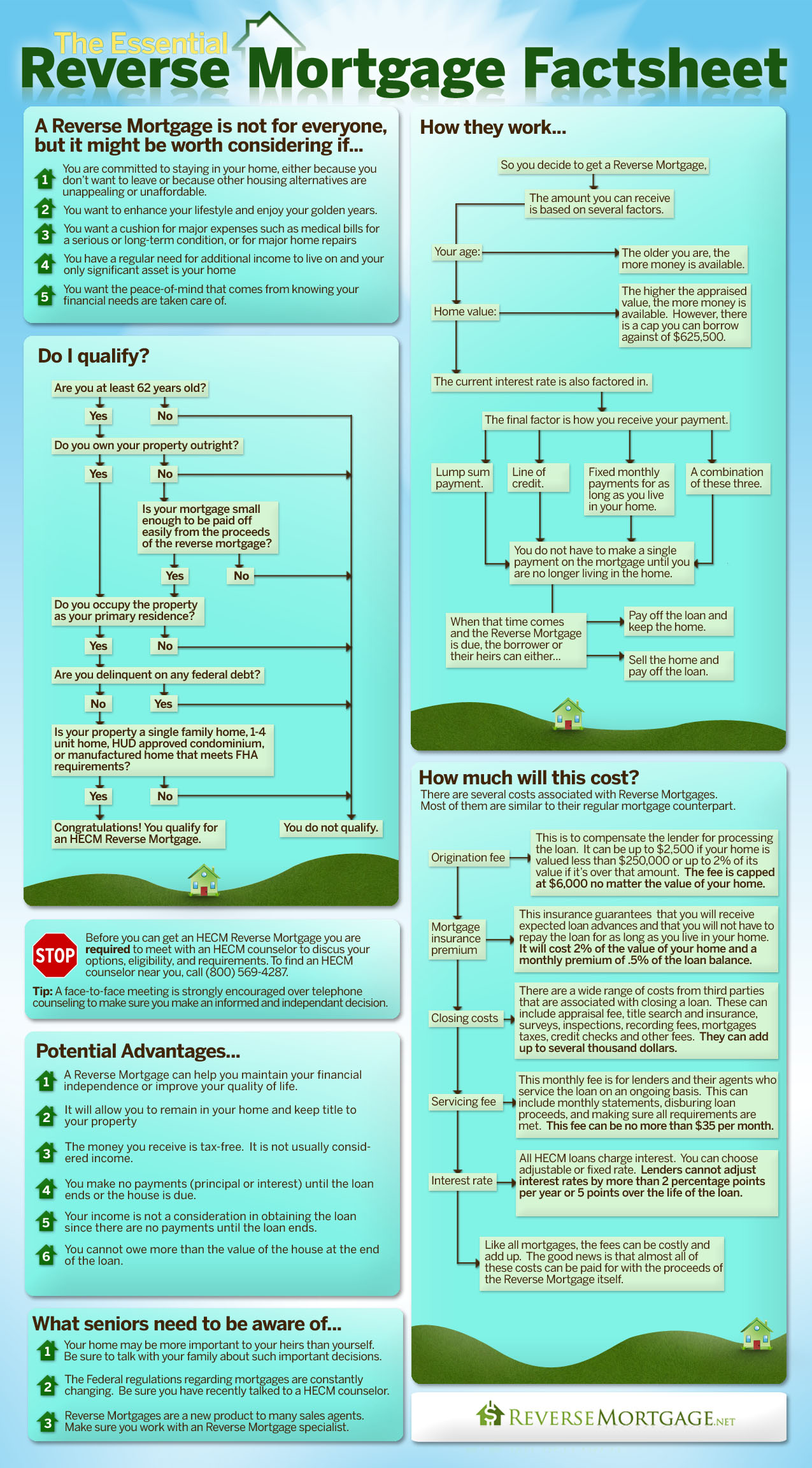
For a reverse home mortgage to be a feasible financial choice, existing home mortgage balances generally must be low enough to be paid off with the reverse home mortgage earnings. Nevertheless, debtors do have the alternative of paying down their existing home loan balance to receive a HECM reverse home loan. The HECM reverse home loan follows the basic FHA eligibility requirements for home type, meaning most 14 family homes, FHA approved condominiums, and PUDs certify.
Prior to beginning the loan procedure for an FHA/HUD-approved reverse home loan, applicants need to take an authorized therapy course. An approved counselor ought to help discuss how reverse mortgages work, the financial and tax ramifications of here getting a reverse home mortgage, payment alternatives, and expenses associated with a reverse mortgage. The therapy is indicated to safeguard customers, although the quality of therapy has actually been slammed by groups such as the Customer Financial Defense Bureau. how do escrow accounts work for mortgages.
On March 2, 2015, FHA executed new guidelines that require reverse home loan applicants to undergo a financial assessment. Though HECM debtors are not needed to make month-to-month mortgage payments, FHA wants to make sure they have the monetary ability and willingness to stay up to date with residential or commercial property taxes and house owner's insurance (and any other applicable property charges).
Prior to 2015, a Lender might not refuse a request for a HECM as the requirement is age 62+, own a house, and meet preliminary debt-to-equity requirements. With FA, the loan provider may now require Equity "set aside" rules and sums that make the loan impossible; the like a declination letter for poor credit.
See This Report on Which Credit Report Is Used For Mortgages
Acceptable credit - All real estate and installment financial obligation payments must have been made on time in the last 12 months; there disappear than two 30-day late home mortgage or installment payments in the previous 24 months, and there is no significant derogatory credit on revolving accounts in the last 12 months.
If no extenuating circumstances can be recorded, the debtor might not certify at all or the lending institution might need a big quantity of the primary limitation (if offered) to be taken into a Life Span Reserve (LESA) for the payment of home charges (real estate tax, homeowners insurance coverage, etc.).
The fixed-rate program comes with the security of a rate of interest that does not alter for the life of the reverse home mortgage, however the rates of interest is typically greater at the start of the loan than a similar adjustable-rate HECM. Adjustable-rate reverse home mortgages usually have interest rates that can change on a monthly or yearly basis within particular limits.
The initial rates of interest, or IIR, is the actual note rate at which interest accumulates on the outstanding loan balance on an annual basis. For fixed-rate reverse home mortgages, the IIR can never alter. For adjustable-rate reverse mortgages, the IIR can alter with program limits approximately a lifetime interest rate cap.
The 6-Minute Rule for What You Need To Know About Mortgages
The EIR is frequently various from the real note rate, or IIR. The EIR does not figure out the quantity of interest that accumulates on the loan balance (the IIR does that). The total pool of money that a borrower can receive from a HECM reverse home mortgage is called the primary limitation (PL), which is determined based on the maximum claim amount (MCA), the age of the youngest debtor, the predicted rates of interest (EIR), and a table to PL factors released by HUD.
A lot of PLs are generally in the variety of 50% to 60% of the MCA, however they can sometimes be greater or lower. The table listed below provides examples of principal limits for various ages and EIRs and a property worth of $250,000. Customer's age at origination Anticipated rates of interest (EIR) Principal limit aspect (as of Aug.
To put it simply, older borrowers tend to qualify for more cash than younger customers, however the overall quantity of cash available under the HECM program tends to reduce for any ages as interest rates increase. Closing costs, existing home loan balances, other liens, and any property taxes or property owners insurance coverage due are usually paid of the preliminary primary limitation.
The cash from a reverse mortgage can be distributed in 4 methods, based upon the borrower's monetary requirements and goals: Swelling amount in money at settlement Monthly payment (loan advance) for a set variety of years (term) or life (tenure) Line of credit (comparable to a home equity credit line) Some mix Click for more info of the above Note that the adjustable-rate HECM provides all of the above payment options, but the fixed-rate HECM just uses lump sum.
The Best Strategy To Use For What Happens To Mortgages In Economic Collapse
This suggests that borrowers who decide for a HECM credit line can possibly get to more cash over time than what they at first certified for at origination. The line of credit development rate is identified by adding 1.25% to the preliminary rates of interest (IIR), which implies the line of credit will grow quicker if the rate of interest on the loan boosts.
Because numerous borrowers were http://travisbvwb478.bearsfanteamshop.com/h1-style-clear-both-id-content-section-0-all-about-what-credit-score-do-banks-use-for-mortgages-h1 taking complete draw swelling amounts (frequently at the encouragement of lending institutions) at closing and burning through the cash rapidly, HUD looked for to secure customers and the viability of the HECM program by limiting the quantity of proceeds that can be accessed within the first 12 months of the loan.
/what-is-an-adjustable-rate-mortgage-3305811_V2-d24ce035796b4b3ebb7cee3f65049a24.png)
Any staying readily available earnings can be accessed after 12 months. If the total mandatory commitments surpass 60% of the principal limit, then the customer can draw an extra 10% of the primary limitation if available. The Real Estate and Economic Recovery Act of 2008 supplied HECM mortgagors with the opportunity to buy a new principal residence with HECM loan continues the so-called HECM for Purchase program, reliable January 2009.
The program was designed to allow the senior to acquire a new primary home and acquire a reverse mortgage within a single deal by eliminating the requirement for a second closing. Texas was the last state to enable for reverse mortgages for purchase. Reverse home loans are frequently criticized over the issue of closing costs, which can often be pricey.
The 6-Second Trick For Obtaining A Home Loan And How Mortgages Work
Considering the constraints enforced upon HECM loans, they are similar to their "Forward" contemporaries in total costs. The following are the most typical closing costs paid at closing to obtain a reverse home loan: Therapy fee: The very first action to get a reverse mortgage is to go through a counseling session with a HUD-approved therapist.
Origination fee: This is charged by the loan provider to arrange the reverse mortgage. Origination charges can vary extensively from loan provider to loan provider and can range from absolutely nothing to an optimum of $6,000. Third-party fees: These fees are for third-party services worked with to complete the reverse home loan, such as appraisal, title insurance coverage, escrow, federal government recording, tax stamps (where applicable), credit reports, and so on.
The IMIP protects lending institutions by making them whole if the home costs the time of loan repayment for less than what is owed on the reverse home mortgage. This protects debtors too since it implies they will never ever owe more than their house is worth. Since 1/2019, the IMIP is now 2% of the max claim amount (Either the appraised worth of the house approximately an optimum of $726,535) The yearly MIP (home loan insurance premium) is.50% of the exceptional loan balance.